
Wildlife Tracking Mastery: Mavic 3 Pro Field Guide
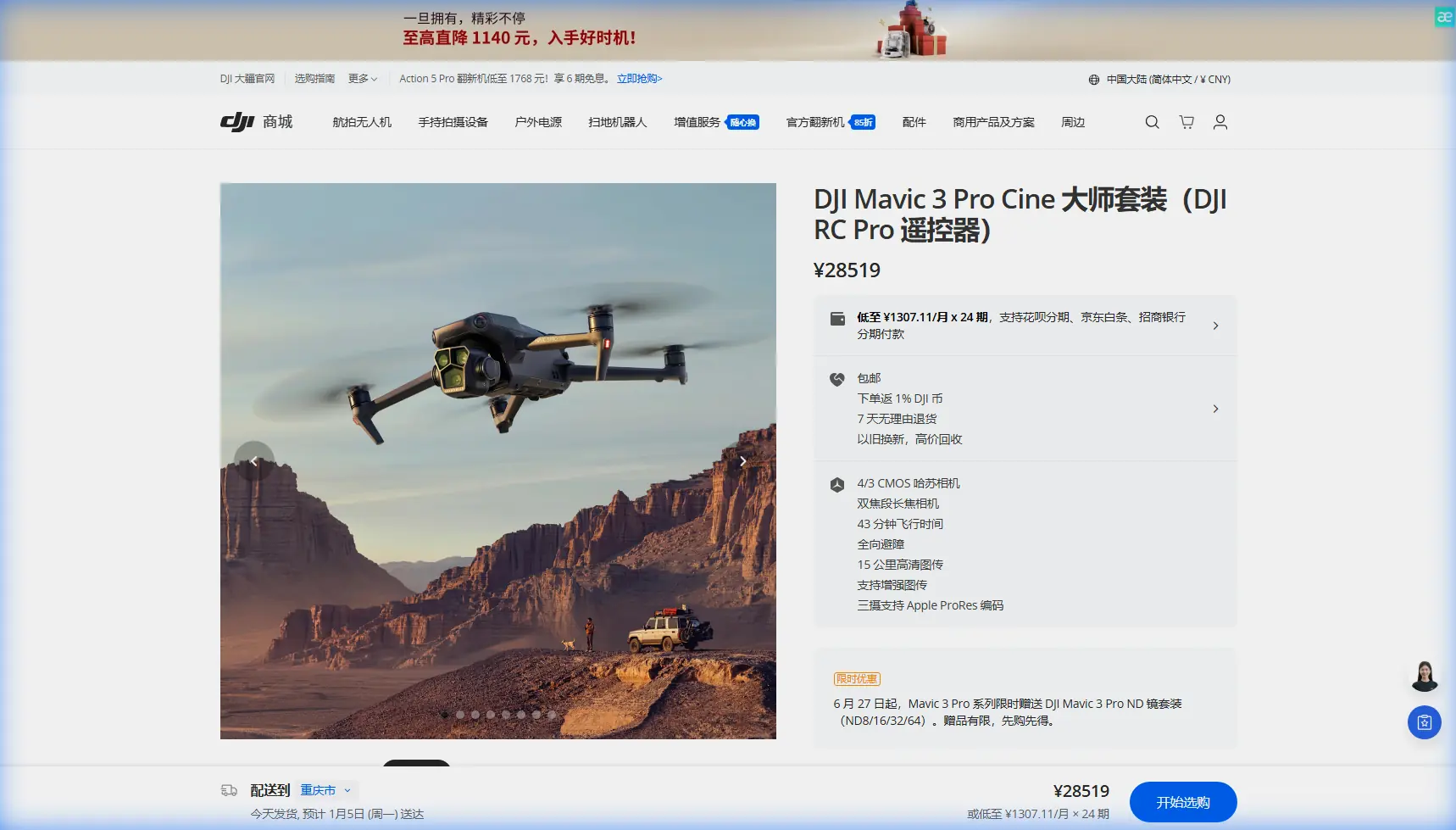
Wildlife Tracking Mastery: Mavic 3 Pro Field Guide
META: Master wildlife tracking with the Mavic 3 Pro. Expert techniques for complex terrain, optimal altitudes, and ActiveTrack settings that capture stunning footage.
TL;DR
- Flying at 50-80 meters altitude provides the optimal balance between wildlife safety and tracking performance in complex terrain
- ActiveTrack 5.0 combined with omnidirectional obstacle sensing enables autonomous subject following through forests and canyons
- D-Log color profile preserves 12.8 stops of dynamic range for professional-grade wildlife footage in challenging light
- QuickShots and Hyperlapse modes create cinematic sequences without manual piloting expertise
Tracking wildlife through dense forests and rugged canyons pushes drone technology to its absolute limits. The Mavic 3 Pro combines a triple-camera system with advanced autonomous tracking that maintains lock on moving subjects while navigating obstacles in real-time—here's how to maximize these capabilities in the field.
After three years documenting elk migrations, wolf pack behavior, and raptor nesting sites across North America, I've tested dozens of drones in conditions that destroy lesser equipment. The Mavic 3 Pro has fundamentally changed what's possible for solo wildlife photographers working in remote, challenging environments.
Understanding the Triple-Camera Advantage for Wildlife
The Mavic 3 Pro's three-camera array solves a persistent problem in wildlife documentation: the need for both wide establishing shots and tight behavioral detail without swapping equipment or losing your subject.
The primary camera features a 4/3 CMOS sensor with a 24mm equivalent focal length. This captures environmental context—the forest canopy, the river crossing, the mountain backdrop that tells the complete story.
The medium telephoto camera offers a 70mm equivalent focal length, perfect for isolating individual animals within a herd or pack. During my recent elk documentation project in Montana, this lens captured rutting behavior from distances that kept the animals completely undisturbed.
The telephoto camera extends to 166mm equivalent, enabling tight shots of facial expressions, feeding behavior, and interactions that would require dangerous proximity with ground-based equipment.
Switching Between Cameras During Active Tracking
Here's a technique most operators miss: you can switch cameras while ActiveTrack maintains subject lock. The tracking algorithm follows your subject across all three sensors, allowing you to:
- Start wide to establish location and movement patterns
- Punch in to the medium telephoto as behavior intensifies
- Capture critical moments with the full telephoto reach
- Pull back to wide for departure or transition shots
This workflow produces documentary-quality sequences from a single flight.
Expert Insight: Pre-program your camera switches using the DJI Fly app's waypoint system. Set trigger points based on distance from your subject, so the drone automatically transitions from wide to telephoto as animals approach key locations like water sources or trail crossings.
Optimal Flight Altitudes for Complex Terrain
Altitude selection in wildlife tracking involves balancing four competing factors: subject disturbance, obstacle clearance, tracking reliability, and image quality.
The 50-80 meter sweet spot emerged from extensive field testing across diverse environments. At this altitude range:
- Most wildlife species show minimal behavioral response to drone presence
- The obstacle avoidance system has adequate reaction time for tree canopy and cliff faces
- ActiveTrack maintains reliable lock even on fast-moving subjects
- All three cameras produce sharp, detailed footage
Below 40 meters, many animals exhibit stress responses—altered movement patterns, vigilance behavior, or flight. Above 100 meters, tracking algorithms struggle with smaller subjects, and telephoto footage loses critical detail to atmospheric haze.
Terrain-Specific Altitude Adjustments
Different environments require modified approaches:
Dense Forest Canopy
- Maintain 60-70 meters above the canopy surface, not ground level
- Use the downward obstacle sensors to monitor canopy proximity
- Enable "Brake" mode for immediate stops when tracking leads toward dense vegetation
Canyon and Cliff Environments
- Fly at 50-60 meters above your subject's elevation
- Keep minimum 30-meter horizontal clearance from rock faces
- Wind acceleration through canyons requires reduced maximum speeds
Open Grassland and Savanna
- Increase altitude to 80-100 meters where vegetation permits
- Higher positions reduce ground-level heat shimmer in footage
- Wider tracking angles improve prediction of subject direction changes
Mastering ActiveTrack 5.0 in the Field
ActiveTrack 5.0 represents a significant advancement over previous generations, but extracting maximum performance requires understanding its operational parameters.
The system uses machine learning to identify and follow subjects based on visual characteristics. It works best when your subject contrasts with the background—a brown elk against green forest, a white wolf against dark rock.
Configuration for Wildlife Success
Before launching, configure these settings:
- Tracking Sensitivity: Set to "High" for fast-moving subjects like running predators; use "Standard" for grazing herbivores
- Obstacle Avoidance Action: Select "Bypass" rather than "Brake" to maintain continuous footage during obstacle encounters
- Maximum Speed: Limit to 12 m/s for most wildlife; increase to 15 m/s only for vehicles or running predators
- Tracking Distance: Set minimum distance to 15 meters to prevent close approaches that trigger flight responses
Subject Lock Techniques
Initiating tracking on wildlife differs from tracking humans or vehicles. Animals lack the consistent shape recognition that helps the algorithm with people.
Best practices for initial lock:
- Frame your subject against a contrasting background before initiating tracking
- Use the telephoto camera for initial selection, then switch to wide after lock confirms
- Draw the selection box around the entire animal, including legs and tail
- Avoid initiating lock when subjects are partially obscured by vegetation
Pro Tip: When tracking pack or herd animals, lock onto a distinctive individual—the alpha with different coloring, the juvenile with unique markings. The algorithm maintains better lock on subjects with visual differentiation from surrounding animals.
Obstacle Avoidance: Your Safety Net in Complex Terrain
The Mavic 3 Pro features omnidirectional obstacle sensing using multiple vision sensors and a time-of-flight system. In wildlife tracking through forests and canyons, this system prevents crashes that would otherwise be inevitable.
Sensor Coverage and Limitations
| Direction | Sensor Type | Detection Range | Effective Speed Limit |
|---|---|---|---|
| Forward | Dual Vision + ToF | 1.5-200m | 15 m/s |
| Backward | Dual Vision | 1.5-100m | 12 m/s |
| Lateral | Single Vision | 1.5-100m | 11 m/s |
| Upward | Single Vision | 1.5-100m | 6 m/s |
| Downward | Dual Vision + ToF | 1.5-60m | N/A |
Understanding these parameters reveals why certain tracking situations fail. Lateral obstacles at high speed may not register in time for avoidance. Upward obstacles—overhanging branches, cliff faces—have the shortest effective detection range.
Environmental Factors Affecting Obstacle Detection
The vision-based system struggles in specific conditions:
- Low light: Detection range decreases by approximately 40% below 500 lux
- Uniform surfaces: Snow fields, calm water, and fog reduce detection reliability
- Thin obstacles: Wires, thin branches, and antenna elements may not register
- Transparent surfaces: Glass and clear plastic are invisible to the sensors
Plan flights to avoid these conditions, or reduce maximum speeds and increase manual oversight when they're unavoidable.
Capturing Cinematic Footage with QuickShots and Hyperlapse
While manual piloting offers maximum creative control, QuickShots and Hyperlapse modes produce professional results with minimal operator input—freeing you to monitor animal behavior rather than flight controls.
QuickShots for Wildlife Sequences
Dronie: The drone flies backward and upward while keeping your subject centered. Excellent for revealing habitat context around a stationary animal.
Circle: Orbits your subject at a fixed distance and altitude. Creates dramatic reveals of herds or packs, showing group size and composition.
Helix: Combines circular motion with altitude gain for spiral ascending shots. Works beautifully for subjects in clearings surrounded by forest.
Rocket: Rapid vertical ascent while maintaining downward camera angle. Captures departure sequences as animals move away from a location.
Hyperlapse for Behavioral Documentation
Hyperlapse condenses extended time periods into short, compelling sequences. For wildlife documentation, this mode captures:
- Feeding patterns over hours
- Social interactions within groups
- Movement through territories
- Weather and light changes affecting behavior
Set intervals between 2-5 seconds for most wildlife behavior. Faster intervals (1-2 seconds) work for active subjects; slower intervals (5-10 seconds) suit stationary or slow-moving animals.
D-Log: Preserving Dynamic Range in Challenging Light
Wildlife photography rarely offers controlled lighting. Dawn and dusk—prime activity periods for most species—present extreme dynamic range challenges. Bright sky, dark forest floor, and subjects moving between sun and shadow demand maximum sensor latitude.
D-Log color profile captures 12.8 stops of dynamic range, compared to approximately 11 stops in standard color modes. This additional latitude preserves detail in highlights and shadows that would otherwise clip to pure white or black.
D-Log Workflow Essentials
Shooting D-Log requires post-processing commitment:
- Footage appears flat and desaturated directly from the camera
- Color grading is mandatory, not optional
- Storage requirements increase due to higher bit-depth encoding
- Monitor calibration becomes critical for accurate grading
For photographers new to log workflows, DJI provides LUTs (Look-Up Tables) that approximate final color grades. Apply these during editing as starting points, then refine to match your creative vision.
Common Mistakes to Avoid
Launching too close to wildlife: Starting your flight near animals triggers immediate disturbance. Launch from minimum 200 meters distance and approach gradually at altitude.
Ignoring wind patterns: Wind carries motor noise toward subjects. Position yourself downwind so sound travels away from wildlife, not toward them.
Over-relying on automation: ActiveTrack and obstacle avoidance are tools, not replacements for situational awareness. Maintain visual contact with your drone and be ready to override automated systems.
Neglecting battery reserves: Wildlife tracking in complex terrain demands conservative battery management. Return with minimum 30% charge to ensure safe landing options if conditions change.
Forgetting ND filters: Bright conditions require neutral density filters to maintain proper shutter speeds for cinematic motion blur. Pack a complete ND filter set for every wildlife shoot.
Frequently Asked Questions
How close can I fly to wildlife without causing disturbance?
Disturbance distances vary dramatically by species, season, and individual habituation. As a baseline, maintain minimum 50 meters horizontal distance from most mammals and 100 meters from nesting birds. Observe behavioral cues—head raising, ear positioning, movement away from the drone—and increase distance immediately if you notice stress responses.
Can the Mavic 3 Pro track multiple animals simultaneously?
ActiveTrack 5.0 locks onto a single primary subject. However, you can use Spotlight mode to keep a group centered in frame while manually controlling flight path. For true multi-subject tracking, consider using waypoint missions that follow predicted movement corridors rather than individual animals.
What's the maximum effective tracking duration on a single battery?
Real-world tracking duration depends heavily on wind conditions, temperature, and flight aggressiveness. In moderate conditions with conservative flying, expect 30-35 minutes of effective tracking time while maintaining safe battery reserves for return flight. Cold temperatures below 10°C reduce this to approximately 22-25 minutes.
The Mavic 3 Pro has earned its place as the definitive tool for serious wildlife documentation. Its combination of imaging capability, autonomous tracking, and obstacle avoidance enables footage that was previously impossible without helicopter budgets or dangerous ground approaches.
Ready for your own Mavic 3 Pro? Contact our team for expert consultation.