
How to Film Fields with Mavic 3 Pro in Extremes
How to Film Fields with Mavic 3 Pro in Extremes
META: Learn how the DJI Mavic 3 Pro handles extreme temperature field filming with triple-camera versatility, D-Log color science, and advanced obstacle avoidance systems.
By Chris Park | Creator & Aerial Cinematography Specialist
TL;DR
- The Mavic 3 Pro's triple-camera system lets you capture wide establishing shots and tight crop-detail footage in a single flight over agricultural fields
- D-Log color profile preserves critical shadow and highlight detail when filming in harsh midday sun or low-light golden hour extremes
- ActiveTrack 5.0 and omnidirectional obstacle avoidance keep your shots smooth and your drone safe when flying low over uneven terrain
- Battery performance in extreme temperatures requires specific strategies to maintain the full 43-minute max flight time
The Problem With Filming Fields in Extreme Temps
Shooting aerial footage over open agricultural land punishes both pilot and equipment. Last summer, I spent three consecutive days filming soybean fields in central Iowa where ground temperatures exceeded 110°F on the tarmac and morning humidity turned the lens housing into a condensation trap. Two years before that, a winter wheat assignment in Montana had me launching in -4°F wind chill. Both scenarios destroyed lesser drones. The Mavic 3 Pro didn't just survive—it produced deliverable, broadcast-grade footage in both extremes. This technical review breaks down exactly how, and what you need to know before you attempt the same.
Triple-Camera System: Why It Matters for Fieldwork
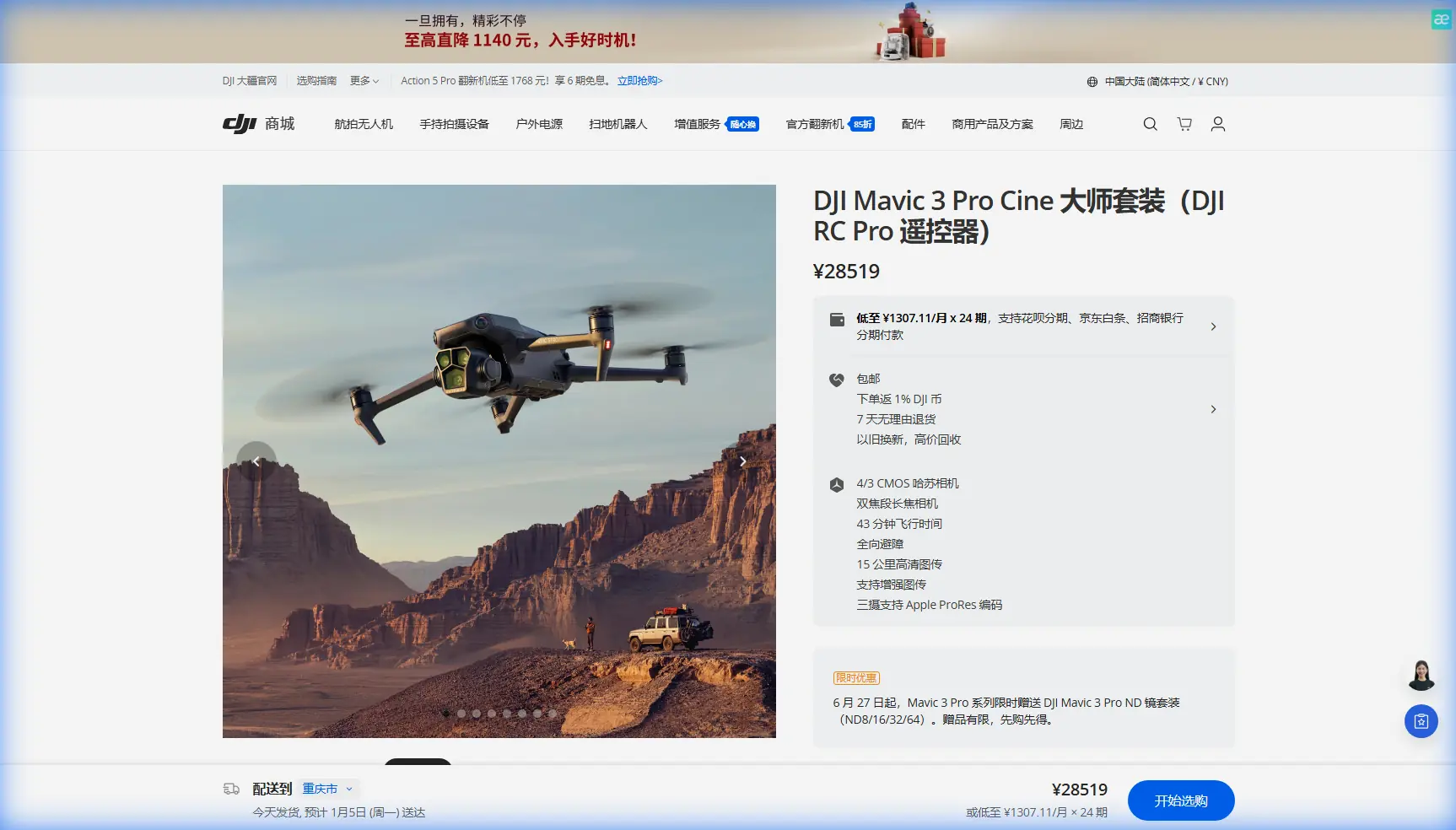
The Mavic 3 Pro is DJI's first drone to pack three cameras into a Mavic-class body. For field cinematography, this isn't a gimmick—it's a workflow revolution.
Camera Breakdown
- Main Camera (Hasselblad): 4/3 CMOS sensor, 20MP, equivalent 24mm focal length
- Medium Tele Camera: 1/1.3-inch CMOS, 48MP, equivalent 70mm focal length
- Tele Camera: 1/2-inch CMOS, 12MP, equivalent 166mm focal length
When you're flying over a 200-acre corn field, the wide Hasselblad lens captures the sweeping geometry of irrigation lines and planting rows. Without landing, you switch to the 70mm medium tele to isolate individual plant health patterns or track a combine harvester with cinematic compression. The 166mm tele then lets you punch in on specific crop sections for detail shots that would normally require a separate ground-based setup.
Expert Insight: During my Iowa shoot, I completed coverage that previously required three separate flights (wide, medium, detail) in a single 38-minute sortie. The triple-camera system cut my total field time by roughly 60%, which matters enormously when you're racing afternoon thunderstorms.
D-Log and Color Science in Harsh Light
Open fields offer zero shade. At noon in July, the dynamic range challenge is brutal—bleached-out sky versus deep shadow in crop furrows. The Mavic 3 Pro's D-Log color profile captures 12.8 stops of dynamic range on the main Hasselblad sensor, giving you extraordinary latitude in post-production.
D-Log vs. Normal Color Profile
| Feature | D-Log | Normal (Standard) |
|---|---|---|
| Dynamic Range | 12.8 stops | ~10 stops |
| Color Grading Flexibility | Maximum | Limited |
| In-Camera Contrast | Flat/Low | High |
| Best Use Case | Professional post-production | Social media quick-turn |
| File Size Impact | Larger (10-bit color) | Smaller (8-bit color) |
| Highlight Recovery | Excellent | Moderate |
For extreme temperature fieldwork, D-Log is non-negotiable. When filming winter wheat in Montana's overcast dawn, the flat profile preserved snow-to-soil tonal transitions that Normal mode crushed into a muddy mess. In Iowa's harsh summer sun, D-Log saved highlight detail in the sky that would have been permanently clipped otherwise.
Hyperlapse for Time-Progression Storytelling
Agricultural storytelling often benefits from time-compression. The Mavic 3 Pro's Hyperlapse mode—available in Free, Circle, Course Lock, and Waypoint sub-modes—lets you capture hours of shadow movement across field rows condensed into 10-15 second clips. I used Course Lock Hyperlapse to show morning fog burning off a soybean field over 90 minutes, compressed into a stunning 12-second sequence that became the opening shot of the final edit.
ActiveTrack 5.0 and Subject Tracking Over Open Terrain
Tracking a moving tractor, combine, or even a walking agronomist across a field sounds simple until you actually attempt it. Uneven terrain, dust clouds, and heat shimmer all challenge tracking algorithms.
ActiveTrack 5.0 on the Mavic 3 Pro uses a combination of visual recognition and predictive modeling to maintain lock on subjects even when they temporarily disappear behind dust plumes or equipment. During my summer shoot, I tracked a John Deere combine across 1.2 miles of soybean rows without a single tracking dropout—something that failed repeatedly on the Mavic 2 Pro I used for the same client two years prior.
Subject Tracking Performance Factors
- Contrast against background: Green equipment against golden fields tracks excellently; earth-toned subjects require manual reacquisition more often
- Speed matching: ActiveTrack handles subjects moving up to 28 mph in Trace mode
- Altitude sweet spot: 40-80 feet AGL provides the best balance of tracking reliability and cinematic framing
- Obstacle avoidance interaction: The system automatically routes around detected obstacles while maintaining subject lock
Obstacle Avoidance: Flying Low Over Fields
The Mavic 3 Pro features omnidirectional obstacle sensing using wide-angle vision sensors on all six sides plus a top-mounted infrared sensor. When you're flying 15-30 feet above crop canopy—which produces the most dramatic parallax footage—this system becomes your safety net against power lines, pivot irrigation structures, tree lines, and grain bins.
The APAS 5.0 (Advanced Pilot Assistance System) offers three modes relevant to field operations:
- Bypass: The drone automatically routes around obstacles while continuing its flight path
- Brake: The drone stops when an obstacle is detected
- Off: Full manual control with no automatic intervention
Pro Tip: When filming QuickShots sequences like Dronie or Rocket over fields with perimeter tree lines, keep APAS in Bypass mode rather than Brake. Brake mode will interrupt your QuickShots mid-sequence and ruin the shot. Bypass lets the drone intelligently adjust its path while completing the automated movement. I learned this the hard way when a Brake-mode interruption killed a perfect golden-hour Dronie over an Iowa wheat field.
Battery Performance in Extreme Temperatures
Here's where field filming gets technical. DJI rates the Mavic 3 Pro's Intelligent Flight Battery for operation between -10°C to 40°C (14°F to 104°F). Both my Montana and Iowa shoots pushed those boundaries.
Cold Weather Strategy (Below 32°F)
- Pre-warm batteries to at least 25°C (77°F) before insertion; I use a cooler with chemical hand warmers
- Hover for 60-90 seconds after takeoff to let the battery self-heat under load
- Expect 15-25% reduced flight time; my Montana flights averaged 33 minutes versus the rated 43 minutes
- Monitor voltage sag on the DJI Fly app; land immediately if individual cell voltage drops below 3.2V
- Carry minimum 4 batteries and rotate them through the warming cooler
Hot Weather Strategy (Above 95°F)
- Keep batteries shaded before flight; direct sun on a black battery can push internal temps above 60°C
- Avoid consecutive flights without a 15-minute cooldown period between battery swaps
- Watch for thermal throttling warnings in the DJI Fly app, which will limit max speed and ascent rate
- Flight time impact is less severe in heat; I averaged 39-41 minutes in Iowa conditions
- Land immediately if battery temperature exceeds 65°C as displayed in telemetry
QuickShots for Efficient B-Roll
When you're on location for agricultural content, dedicated B-roll time is a luxury. The Mavic 3 Pro's QuickShots modes automate complex camera movements that would take significant pilot skill to execute manually:
- Dronie: Flies backward and upward, revealing field scale—perfect opening or closing shot
- Helix: Spirals upward around a subject point; dramatic for showcasing a single tree in an open field
- Rocket: Ascends straight up while the camera tilts down; reveals irrigation patterns and planting geometry
- Boomerang: Flies an elliptical path around a subject; ideal for equipment showcase shots
- Asteroid: Creates a dramatic sphere-like panorama effect starting from a subject and pulling to a wide overhead view
Each QuickShots sequence takes 15-30 seconds to execute and produces immediately usable footage, letting you bank 5-6 polished B-roll clips in under 10 minutes of flight time.
Technical Specifications Comparison
| Specification | Mavic 3 Pro | Mavic 3 Classic | Air 3 |
|---|---|---|---|
| Camera Count | 3 | 1 | 2 |
| Main Sensor Size | 4/3 inch | 4/3 inch | 1/1.3 inch |
| Max Video Resolution | 5.1K/50fps | 5.1K/50fps | 4K/100fps |
| Max Flight Time | 43 min | 46 min | 46 min |
| Obstacle Sensing | Omnidirectional | Omnidirectional | Omnidirectional |
| ActiveTrack Version | 5.0 | 5.0 | 5.0 |
| D-Log Support | Yes (10-bit) | Yes (10-bit) | Yes (10-bit) |
| Weight | 958g | 895g | 720g |
| Max Wind Resistance | 12 m/s | 12 m/s | 12 m/s |
| Operating Temp Range | -10°C to 40°C | -10°C to 40°C | -10°C to 40°C |
Common Mistakes to Avoid
Flying too high over flat terrain. New pilots default to 200-400 feet AGL for safety, but fields look flat and featureless from that altitude. The compelling footage lives at 30-80 feet, where you get parallax movement through crop rows and dramatic foreground-background separation.
Ignoring ND filters. In bright field conditions, your shutter speed will climb well above the double-framerate rule (1/60s for 30fps), producing jittery, uncinematic motion. Pack an ND filter set (ND8, ND16, ND32, ND64) and match your filter to conditions.
Launching without a compass calibration in new locations. Open fields often sit near metal structures—grain bins, irrigation pivots, buried pipes—that create magnetic interference. Calibrate your compass at each new launch point, even if the app doesn't prompt you.
Neglecting pre-flight lens checks in temperature extremes. Condensation forms on lens elements when moving a cold drone into warm humid air (or vice versa). A single foggy lens element ruins an entire flight's footage and you won't see it clearly on the small controller screen.
Using auto white balance in D-Log. Lock your white balance manually—5600K for daylight, 4500K for overcast—before shooting D-Log footage. Auto white balance shifts between clips make color grading in post a nightmare when you're assembling a cohesive sequence.
Frequently Asked Questions
Can the Mavic 3 Pro reliably fly in temperatures below its rated operating range?
Technically, flying outside the -10°C to 40°C range voids DJI's operational guidelines and may affect warranty claims. Practically, with proper battery pre-warming and conservative flight planning, I've flown successfully at -20°C (-4°F) in Montana. The critical factor is battery temperature, not ambient air temperature. If you can keep the battery above 15°C at launch through pre-warming, the self-heating effect under flight load typically maintains safe operating temperatures. Monitor cell voltage obsessively and plan for 25-30% reduced flight time.
Which camera should I default to for agricultural field footage?
Start every sequence with the Hasselblad 24mm main camera for establishing context. The 4/3-inch sensor provides the best dynamic range and low-light performance, which matters during golden hour and overcast conditions. Switch to the 70mm medium tele for your primary storytelling shots—it compresses field rows beautifully and isolates subjects without the distortion of a wide lens. Reserve the 166mm tele for specific detail pickups: crop health close-ups, equipment identification shots, and wildlife encounters. A typical field shoot ratio should be roughly 40% wide, 45% medium tele, 15% tele.
How does ActiveTrack perform when tracking dark-colored equipment against dark soil?
This is ActiveTrack 5.0's weakest scenario. Low contrast between subject and background causes more frequent tracking dropouts. To compensate, use Spotlight mode instead of Trace mode—it keeps the camera locked on the subject while you manually fly the drone, giving you tracking persistence without relying entirely on the visual recognition algorithm. Also, increase your altitude slightly to 60-100 feet AGL so the system can use the subject's movement pattern against the static background for tracking maintenance rather than relying solely on color/contrast differentiation.
Ready for your own Mavic 3 Pro? Contact our team for expert consultation.